The Origin
A name spoken
on volcanic slopes
Chapter I
The Silk Paintings
As a child, the walls of my room held silk paintings my grandfather brought back from Japan — delicate, luminous depictions of volcanoes and tigers that seemed to move in the changing light. He had been part of the post-World War II reconstruction effort, and these paintings were among the few things he carried home.
Those images became my first window into Japan — not as a distant country in a textbook, but as a place of raw natural power and quiet beauty. The volcanoes smoldered with contained energy. The tigers moved through pine forests with a grace that suggested something ancient and untamed.
I didn't know it then, but those paintings were laying the foundation for everything that would come.
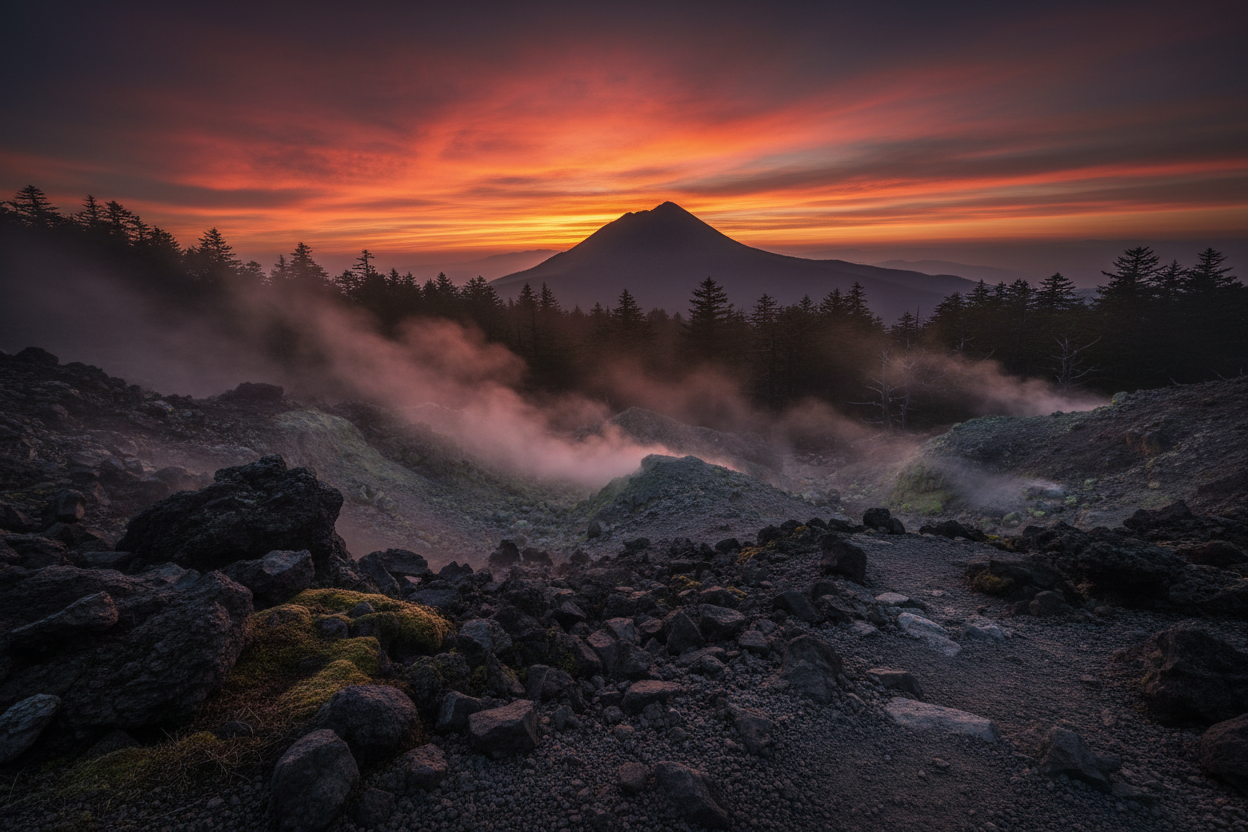
Japanese volcanic terrain — where the earth breathes
Chapter II
The Volcanic Path
Years later, I found myself on the volcanic mountains of Japan — not as a tourist, but as someone drawn to these landscapes the way others are drawn to the sea. Hiking became a practice, and volcanoes became my terrain of choice.
There is something about ascending a volcano that strips away everything unnecessary. The sulfur in the air, the rocky and unstable ground, the wind that cuts through every layer — it demands your full attention. You learn what gear matters. You learn what fails. You learn what the mountain requires.
This experience — documented through my YouTube channel and the Volcanic Japan community — became the testing ground for understanding what alpine gear should truly be.
Chapter III
The Name
I was descending a volcano when it happened. Moving quickly down the trail, my long red hair caught in the wind, flowing behind me like something alive. An older Japanese man was ascending the same path, and as I approached rapidly, I saw his expression shift — a flash of surprise, then recognition, then something close to amusement.
「松の虎」"Matsunotora" — Tiger of the Pines
He said it as if naming something he had seen before — not me specifically, but the image I had become in that moment: a figure moving through the pines and over the rock with the fluidity and agility of a tiger descending through the forest.
I stopped on the trail and felt something I had no immediate word for. Not just gratitude for the compliment, but a sudden, disorienting recognition — as if the mountain had been waiting to say this to me for a very long time.
To add another layer of irony, I was born in the Chinese year of the Wood Tiger. The Wood Tiger, in the cycle of the five elements, is said to embody growth, ambition, and the pioneering impulse — a creature that pushes into new territory not out of recklessness, but out of an innate drive to explore the edge of what is known. Wood feeds fire. The tiger moves through the forest. These were not metaphors I had chosen; they were simply the coordinates of my birth.
What I learned only later deepened the irony further. In Japanese culture, the tiger is a profound paradox: an animal that never walked the islands of Japan yet became one of its most essential spiritual guardians. The tiger exists in Japan entirely through myth, art, and reverence — never through presence. And yet, precisely because of that absence, it became something more than a physical creature. It became a symbol.
In Japanese folklore, the tiger is specifically revered as the Guardian of the Mountains, linked to the mountain deity San Shin, believed to be one of the only creatures capable of matching the power of the mountain spirits themselves. Not dominance over the mountain — but the capacity to stand within it, unbowed.
And now, standing on volcanic ground with pine trees bending in the wind around me, those coordinates had suddenly converged. My grandfather's silk paintings of tigers moving through pine forests. The volcanoes I had spent years ascending. The Japanese mountains that had called to me before I could explain why. A creature that guarded the very terrain I had devoted myself to. And a stranger on a trail, seeing exactly what I had always been.
The name stayed. It wasn't a name I chose — it was a name that had been accumulating across a lifetime, through silk paintings and volcanic slopes and the quiet pull of something ancient I had always followed without knowing where it would lead.

Inspired by my grandfather's silk paintings
Chapter IV
The Brand
Matsunotora is a premium Japanese alpine hiking and style brand born from lived experience on volcanic terrain. Headquartered in Gunma, Japan with a sister location in Los Angeles, we create gear and apparel that bridges the gap between highly technical alpine performance and considered design.
Our first collection begins with headwear — an alpine hiking hat engineered for volcanic conditions and a trucker-style streetwear cap that carries the mountain into the city. Following closely: highly technical volcano packs designed with integrated gear systems specifically for the unique demands of volcanic hiking.
Every piece carries the spirit of the name — the agility of the tiger, the resilience of the pine, and the mysticism of the volcano.